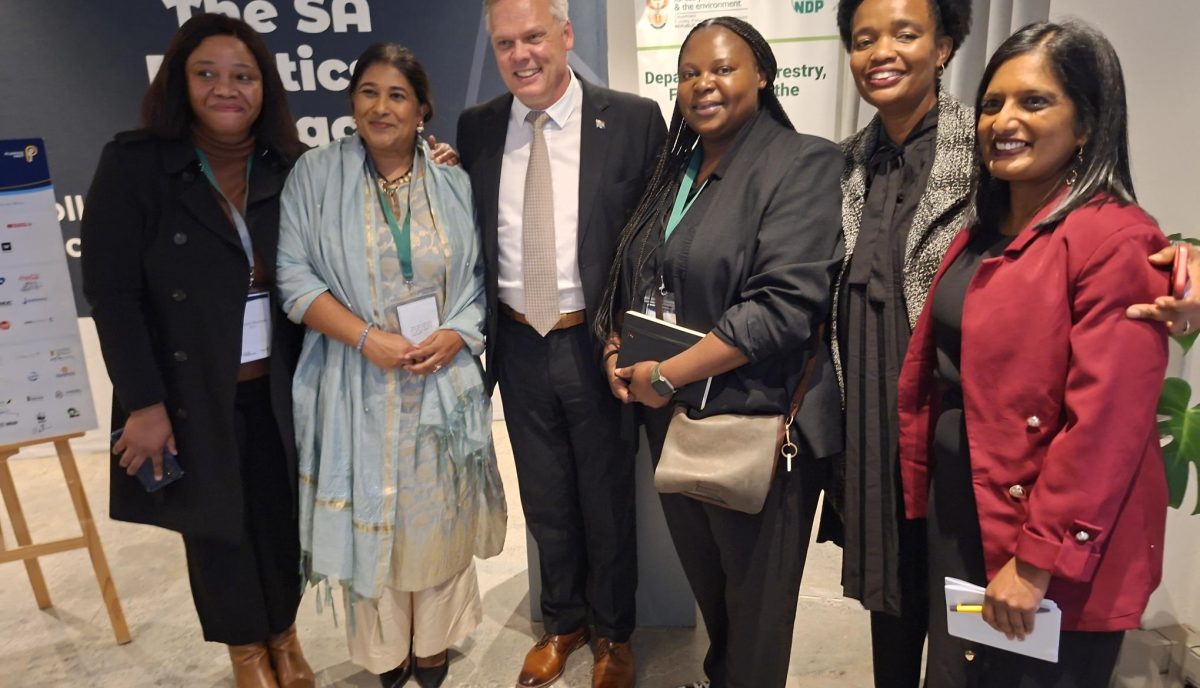
Petco CEO Cheri Scholtz and our value chain officer, Boipelo Madonsela, had the privilege of attending the Plastics Recycling Show Europe 2024 conference in Amsterdam in June.
They travelled to the Netherlands to learn more about emerging global trends and share how the recent legislative developments in Europe will unavoidably impact the South Africa landscape in the future.
For those who were unable to attend, we bring you our key takeaways from the world’s largest plastics recycling trade show. This is a must read for producers (brand owners, retailers and importers), and anyone in the packaging collection and recycling value chain.
Our key takeaways include:
- Important milestones in the implementation of the EU’s new Packaging and Packaging Waste Regulation
- Implications for South African producers, brand owners and recyclers
- The outlook for the European and global rPET value chain
- The European take on AI, separation at source, design for recycling and more!
1. EU Legislation: Packaging and Packaging Waste Regulation (PPWR)
Key Regulations
The PPWR was adopted by the European Parliament on 24 April 2024. Some of the key regulatory timelines are as follows.
By 2030:
- All packaging must be recyclable, except lightweight wood, cork, textile, rubber, ceramics, porcelain, and wax.
- Any plastic part of packaging must contain a minimum percentage of recycled content, recovered from post-consumer plastic waste, and calculated as an average per manufacturing plant and year.
From 2030:
- Packaging must be designed for material recycling. Packaging with a recyclability grade below 70% will not be considered recyclable and may not be placed on the market. Above this threshold, design for recycling will be fostered by eco-modulated fees according to performance grades.
From 2035:
- Packaging must be fit to be sorted into specific waste streams without affecting the recyclability of other waste streams. It must also be recycled at scale, which translates to an annual quantity of recycled material equal to or greater than 55% (30% for wood).
Recycled Content Targets
- 30% for contact-sensitive packaging made from PET
- 30% for single-use plastic beverage bottles made from PET or any other plastic material.
- 35% for other plastic packaging
- 10% for contact-sensitive packaging made from other plastic materials
By 2040, these targets will increase significantly to 65%!
What does this mean for recyclers and producers in SA and other non-EU countries?
- The recycled content targets require investment in recycling infrastructure in Europe. However, investments are not expected to increase substantially to meet these targets. Therefore, the PPWR allows recycled material from non-EU countries. This is a game-changer as the European rPET market previously held a heavy bias towards domestic production. EU buyers are now developing an appetite for non-EU rPET.
- PPWR grants non-EU producers of recycled material entry into the EU market, as their materials are required to meet targets, BUT with stringent conditions on collection (source of the material), and adoption of greater rPET content in the import markets themselves.
- Imports may enter the market only when originating from a country that has equivalent rules concerning the prevention and reduction of emissions into air, water and land associated with recycling operations.
- PPWR requires that packaging and packaged products imported into the EU also comply with the minimum recycled content requirements. Our producer members who import to the EU or who have global targets to meet will have to adhere to these requirements.
- Non-EU recyclers and producers must undergo audit certification by Recyclass to verify EU standards. Certification was therefore a key theme at the PRSE conference.
Other PPWR Requirements
- Waste reduction
- EU countries will have to reduce the volume of packaging waste per capita by 5% by 2030, 10% by 2035, and 15% by 2040 (based on 2018 levels).
- Labelling
- Mandatory labels on packaging must state:
- Material composition
- EU-harmonised sorting instructions, also to be used on bins
- Reuse instructions, where applicable
- Mandatory QR code for reusable packaging
- Reuse and refill
- For alcoholic and non-alcoholic drinks (except milk, wine and some spirits), at least 10% reusable packaging by 2030 and at least 40% by 2040.
The Result: More Transparency
Manufacturers and distributors will need to know their packaging holistically at an unprecedented level, which limits greenwashing.
More PPWR Resources
GET INSIGHTS: PPWR: The best things come in small packages… or do they?
READ ARTICLE: PPWR: The Packaging and Packaging Waste Regulation Explained
WATCH VIDEO: EU’s Trailblazing Packaging Regulation
2. Recycled PET (rPET)
- There has been an increase in the uptake of rPET over the past few years. It is predicted that this will continue over the coming decade. Some of the drivers for increased rPET adoption include legislation, EPR and plastic tax, brand commitment, and decarbonisation.
The graph below shows the rPET market penetration by sector. Interesting to see the predicted trend for food contact rPET. South Africa will likely see similar trends in the years to come, especially with all the additional rPET recycling capacity coming online.
Although there is an increased in the uptake of rPET, in cases where rPET prices are higher than virgin prices, some brand owners opt to switch back to purchasing vPET, resulting in reduced demand for rPET. These are likely brand owners that do not have a strong commitment to sustainability targets.
For more details on the key takeaways across the rPET value chain, please download the Wood Mackenzie analysis.
DOWNLOAD DOCUMENT
3. Other Topics Covered
- Prevention of plastic and resin plastic leakage from formal and informal recycling facilities: Once in the environment, it is almost impossible to remove plastic pellets from the environment. This is essentially microplastic pollution. Something to keep a lookout for when visiting recyclers and buy-back centres (BBCs).
- A shift to AI? A key theme at the conference, AI sorting technologies are gaining popularity. While companies like Dragon Fly are operating in SA (an AI sorting technology being installed at BBCs, material recovery facilities, and some large waste management companies), it would still be used to complement physical sorting for some time to come.
- Sorting: In addition to collection and recycling, we’ll have to focus increasingly on sorting, especially as the targets and standards set by the PPWR will require improved sorting to ensure feedstock is of a high quality for food grade recycled material. There is currently insufficient volume of quality recycled material in the market, so there is a need to improve quality and quantity of post-consumer recyclate (PCR) supply.
- Separation at source: As the global demand for higher quality and quantity of recycled material increases, it will require industry in SA to drive separation-at-source.
- Design for recycling: D4R is still critical in ensuring that packaging is recyclable. Some talks at the conference reiterated that badly designed packaging is problematic. Although eco-modulation is a logical solution, countries (EU and non-EU) with multiple producer responsibility organisations (PROs) are unable to implement eco-modulation due to operating in a competitive environment. This is the same challenge we face in SA. There is a need for PROs to collaborate to achieve harmonisation with regards to eco-modulation.
- Masterbatch and additives: Companies producing and selling masterbatch and additives are also joining the D4R conversation. There were a few talks where such companies presented innovations and solutions on the role of masterbatch and additives in the circular economy.
Overall, the conference played a major role in highlighting the connectedness of the global plastic manufacturing and plastic recycling industry. Currently, because the EU is far ahead the rest of the world in terms of sustainability legislation, any shifts in the EU regulatory space will be felt in most corners of the world.